
The Missing Layer in Founder Performance

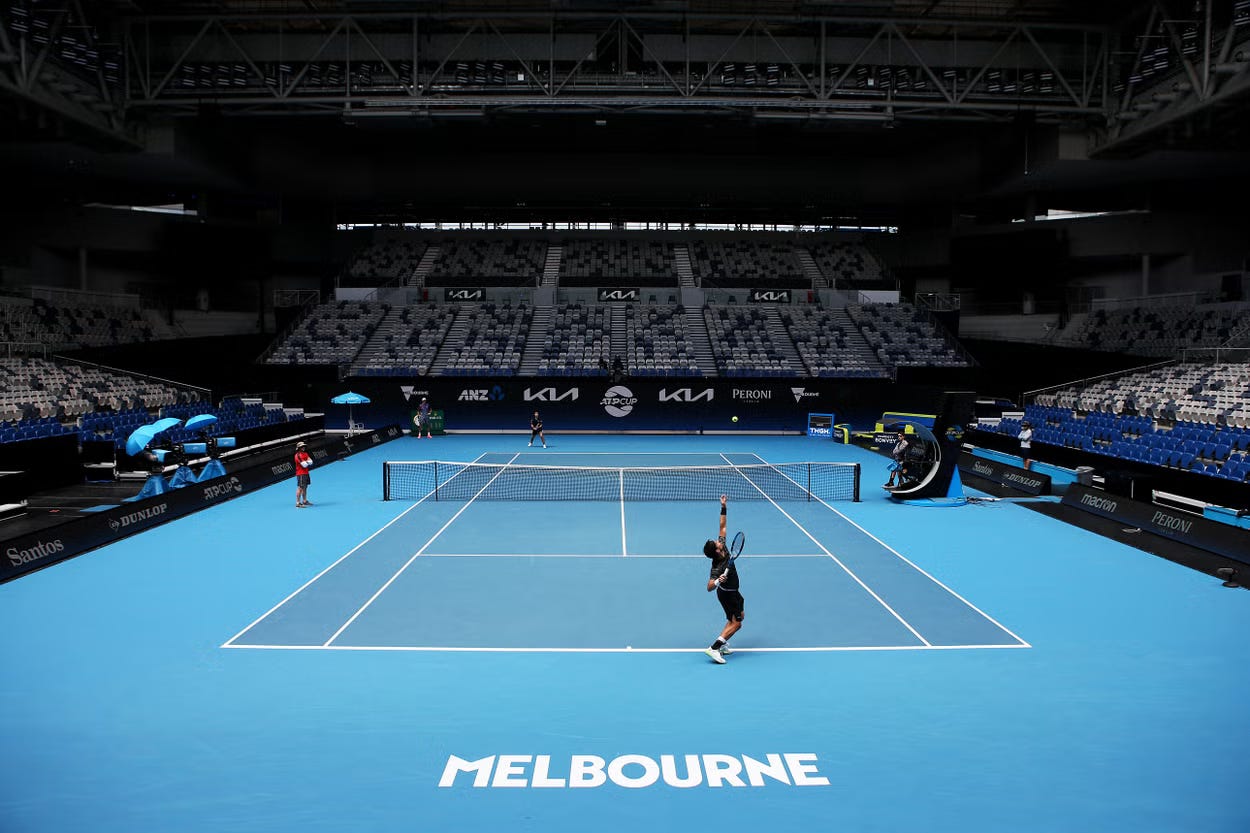
Over the past few weeks, the world has been glued to elite sport.
The Super Bowl.
The Australian Open.
The Winter Olympics.
We focus on the moments that decide everything — the final plays, the pressure, the composure.
But the defining feature of elite sport isn’t the moment.
It’s the infrastructure behind it.
Elite athletes do not rely on talent and discipline alone. They are surrounded by a deliberate performance environment:
Coaches who understand their psychological tendencies under pressure
Staff tracking physical load, sleep, recovery and energy
People adjusting strategy in real time
People reviewing tape, spotting drift, refining execution
Performance is monitored.
It is measured.
It is adjusted.
Nothing meaningful is left to chance.
Now compare that to how founder performance is treated.
Founders don’t prepare for one championship match.
They operate inside sustained pressure.
There isn’t one defining decision. There are hundreds of smaller ones:
Who to hire
When to fire
What to prioritise
When to push
When to conserve capital
What trade-off to accept
Individually, these decisions don’t feel historic.
Collectively, they determine trajectory… and yet, most founders are expected to navigate this without performance infrastructure.
The cognitive load nobody talks about
The founder experience is not just strategic.
It’s neurological.
You are constantly switching contexts:
Strategy → Operations → Hiring → Investor management → Product → Conflict resolution.
Each switch carries cognitive residue.
You are absorbing risk signals all day be it financial, reputational or relational.
You are making high risk decisions with limited data points and so many unknowns.
And more to the point, you are doing this while also being a human being:
Sleeping (or trying to).
Training (or not).
Navigating relationships.
Managing stress.
Performance does not exist in isolation from those variables.
Energy affects judgment.
Sleep affects risk tolerance.
Stress narrows perspective.
Relationship tension reduces patience.
Elite sport integrates these realities into performance design.
Business largely ignores them.
The flawed assumption in business culture
We’ve normalised the idea that high performers should simply be resilient enough.
That intelligence plus grit should carry the load.
But resilience is reactive. Infrastructure is preventative.
Resilience helps you survive stress, infrastructure reduces unnecessary stress before it compounds.
That distinction is critical.
What infrastructure actually means
In business, most “support” looks like advice.
A mentor call.
A board meeting.
A founder dinner.
A podcast.
These are useful.
But they are not infrastructure.
Infrastructure is continuous, not episodic.
It means:
Clear, constrained priorities that are reviewed weekly
A deliberately designed week rather than a reactive calendar
Defined standards for output and behaviour
Structured reflection and adjustment
Accountability that identifies drift early
Someone holding the full picture of your performance, not just the business metrics
Infrastructure creates feedback loops.
It reduces decision fatigue.
It makes the right behaviour easier and the wrong behaviour visible.
Elite athletes operate inside this by default.
Founders rarely do.
The subtle cost of performing alone
Without infrastructure, performance depends on mood, memory and momentum.
Good week → high confidence → strong output.
Poor sleep → lower patience → worse decisions.
Stress spike → reactive calendar → shallow work.
Over time, this variability compounds.
I’ve seen (and experienced) capable founders become the bottleneck in their own companies, not because they lack ability, but because they are carrying sustained cognitive load without structured support.
When performance depends solely on personal discipline, the ceiling lowers quietly.
You don’t notice it immediately, but the results are evident over time.
The contrast we ignore
No elite athlete would step onto the field alone. They would consider it irresponsible.
Yet in business, we’ve normalised solo performance.
We expect founders to:
Manage their own psychology
Design their own weeks
Regulate their own energy
Set their own standards
Hold themselves accountable
All while building something complex and uncertain.
It’s an extraordinary expectation to have and we treat it as normal.
A different way to think about founder performance
What if we treated founder performance the same way elite sport treats athlete performance?
Not with more motivation.
Not with more content.
But instead with infrastructure.
A deliberate performance layer built around the individual:
Structured review
Clear design
Accountability
Adjustment as life changes
Not coaching in the traditional sense, but something closer to having a performance environment intentionally constructed around you.
Because founders don’t lose due to lack of intelligence, they lose due to friction, fatigue and unexamined drift.
Infrastructure reduces all three.
Why this matters to me
I spend most of my time working with founders, operators and investors through The Komo Club and in smaller, private engagements.
One pattern keeps surfacing:
The people carrying the most responsibility are often the ones with the least structured support around their own performance.
That doesn’t make sense.
I’ve been exploring what this kind of performance infrastructure could look like in practice.
Not as a program.
Not as a community.
Not as traditional coaching.
But as a small, private, hands-on model, intentionally limited, built around:
systems, not motivation
accountability, not pressure
performance across the whole human system, not just the business
I’m still validating it, but I wanted to share the idea openly, because I suspect some of you are already feeling what I’m describing — even if you haven’t had language for it yet.
If this resonates, feel free to reply or DM me.
About the author
Rohit Bhargava is a founder, investor and host of The Startup Playbook podcast.
Over the past decade, he has worked across startups as both a founder and an investor — spending time on both sides of the table. More recently, his focus has shifted toward a deeper question:
What actually allows people to perform at a high level over long arcs of uncertainty?
Not just inside the business, but across health, relationships and life more broadly.
His work today centres on performance infrastructure: applying the same clarity, systems thinking and disciplined design used to build great companies to the human building them.
About The Komo Club
The Komo Club is Rohit’s work in practice.
It is a performance and self-leadership platform for founders, operators and leaders who want to operate at a high level without fragmenting their health, relationships or clarity along the way.
Drawing on lessons from elite sport, high-performing teams and startup environments, The Komo Club helps members build deliberate performance infrastructure around their lives.
Through structured cohorts, private engagements and evolving frameworks, the focus is simple:
Increase capacity.
Reduce friction.
Sustain performance over the long term.
About The Life Systems Newsletter
If this piece resonated, you can subscribe below.
This newsletter explores performance infrastructure, decision-making under pressure, and the human systems behind ambitious work.
No noise. No hype. Just practical and structured thinking for people building demanding things.